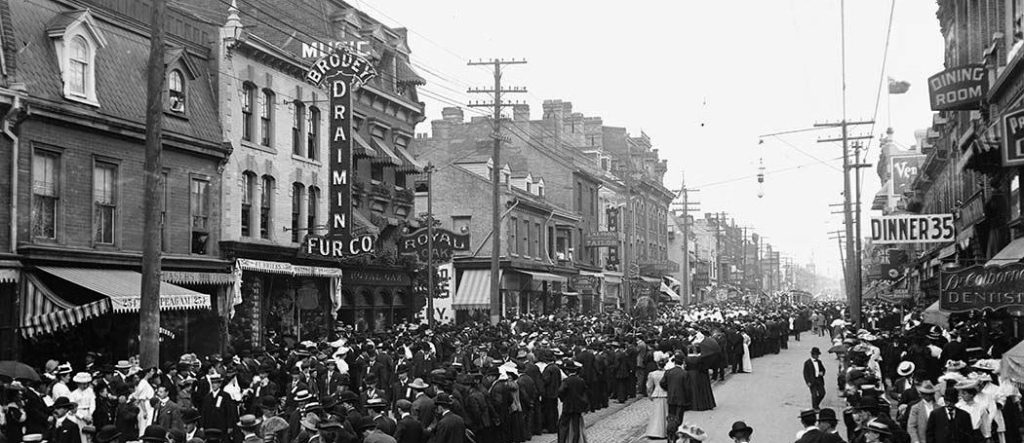
For this Labour Day, let’s take a deep dive on where we’ve come from, what Canadian workers are up against, and the organizing that we need now.
Labour Day didn’t start as a sale or a send-off to summer in Canada. It was born out of confrontation.
In 1872, the Toronto Typographical Union went on strike for a nine-hour workday. What they faced was criminal charges, including prison time. At the time, in Canada – labour organizing was considered an act of criminal conspiracy. The mass rallies that followed grew into a class movement that forced Ottawa to pass the Trade Union Act, which decriminalized the act of unionizing the workplace.
We didn’t get weekends, bans on child labour, workplace safety regulations, or paid leave because bosses found their conscience; we got them because people organized, struck and won. One of the most iconic example of labour action in Canada was the Winnipeg General Strike of 1919; over 30,000 workers shut down a city for six weeks to demand better living wages and the improvement of basic rights.
After the 1872 strike and the legalization of unions, parades and demonstrations became annual reminders that worker’s rights had been fought and won in the streets. By the 1880s, annual celebrations had spread across Canada with annual marches in Hamilton, Ottawa, and Toronto drawing thousands. In 1894, the federal government was pressured into recognizing Labour Day as an official holiday.
It’s important to understand that this recognition isn’t a gift to workers. It was a concession to a mobilized working class. Governments hoped that an official holiday might defuse the militant demands for a May Day workers’ celebration tied more closely to international socialism. Even so, collectively – the parades, picnics and rallies of our early Labour Days kept alive the idea that progress only comes from workers acting together.
Over the decades, the meaning of Labour Day has ebbed and flowed; sometimes being treated as a family outing, other times as a platform for union leaders to denounce worker exploitation and call for reform. The through-line is clear: Labour Day is a mile marker for unfinished struggle, not a final victory lap.
What exactly is the state of Canadian labour in 2025?
We live in an economy where profits and productivity have climbed while wage growth for many has flatlined. The supposed flexibility of gig work often means poverty wages, unpredictable hours, and zero benefits. Temporary foreign workers keep the food supply and care economy running by face extensive sources of exploitation for cheap labour, while healthcare and education workers are asked to absorb crisis after crisis; being told to do more with less in the name of efficiency.
Inflation and climbing housing costs haven’t just squeezed household budgets, they’ve literally rewritten what counts as a decent life. If a full-time job can’t reliably cover rent, groceries, and a surprise bill – that’s not a personal budgeting issues; it’s a political choice.
We’re also seeing a new generation confront old tactics: union-busting consultants, captive-audience meetings, franchising structures designed to fragment workplaces, and independent contractor misclassifcation. In higher education, contract faculty deliver core teaching while getting paid like gig workers. In retail and logistics, algorithmic scheduling treats human beings like interchangeable inventory. And in the public sector, governments flirt with outsourcing under the banner of “innovation,” which too often means siphoning public money to private pockets.
Policy is crucial, but the culture of work matters too. We need to rebuild a work culture where joining a union is as normal as registering to vote; where health and safety committees are active and respected; where grievances are understood as structural problems, not personal failings; and where we talk openly about wages and benefits to break the taboo that protects employers, not workers. A pro‑worker culture also means recognizing that the boss is not your family. Work can be dignified and meaningful—but it’s not a substitute for democracy, public services, or social connection. When employers offer pizza parties instead of pensions, they’re saying the quiet part out loud.
Across the country, workers have reminded us that strikes work. Education staff, grocers, auto workers, delivery drivers, and healthcare workers have pushed back and notched wage gains, job security protections, and staffing ratios. The playbook is familiar: picket lines that hold, community support that grows, and a demand that boils down to respect you can pay the bills with.
It’s true, there have also been defeats—contracts forced by back‑to‑work threats or austerity budgets that squeeze public services. But even these fights clarified public opinion: people know the system is tilted and are more willing than a decade ago to side with the folks who make the country function.
The lesson isn’t complicated: organization precedes negotiation.
The strongest contracts follow the strongest shop‑floor structures, where members know each other, communicate often, and share the work of enforcement long after the photo‑op is over.
So here’s what you can do this week:
Join or build a union. If you don’t have one, talk to a trusted co‑worker and map your workplace—who’s influential, who’s connected, where the pressure points are. Reach out to a union that organizes your sector and get training.
Make it public. Post a pro‑worker message today—share a photo from a local Labour Day parade, lift up a strike fund, or explain why your union matters to you.
Show up. Visit a picket line, attend a union meeting, join a tenants’ union, or volunteer with a migrant rights group. Solidarity is a verb.
Push your representatives. Call or email your MP/MPP/MLA with concrete demands: anti‑scab, card‑check, sectoral standards, paid sick days, pharmacare. Politicians take issues seriously when they hear from organized constituents.
Organize where you live. Start a building association, a mutual aid network, or a childcare co‑op. Workplace power grows when communities are organized.
Labour Day can either be a sentimental nod to past victories—or a springboard for the fights we face ahead. The choice is ours.
The old labour motto still works: What we desire for ourselves, we wish for all.
Let’s make it more than a motto. Let’s build a country where decent work, secure housing, and public services aren’t perks for the lucky few, but the baseline for all Canadians.
 THE GROUNDBREAKER
Leave a comment